

Every specific end-of-the-world date in history has passed without the world ending. From a predicted great flood in 1524 to the Maya calendar in 2012, these predictions follow the same pattern: a confident date, a growing following, a day when nothing happens, and then, very often, a new date rather than a rethink.
Looking back at failed predictions is not about mocking the people who believed them. Many were sincere, some were intelligent, and a few caused real harm. Studying them is one of the best ways to judge the next claim you see on social media.
12 famous end-of-the-world predictions that failed
| Year | Prediction | What happened |
|---|---|---|
| 1000 | The end of the first Christian millennium | Daily life went on; modern historians think the panic was exaggerated later |
| 1524 | A great flood caused by planets meeting in Pisces | February 1524 was a dry month |
| 1666 | The “number of the beast” year | London had a great fire, not an apocalypse |
| 1844 | The return of Christ on 22 October | The “Great Disappointment” |
| 1910 | Poison gas from Halley’s Comet | Earth passed through the tail unharmed |
| 1914 | The end of the present world order | The First World War began, but the world continued |
| 1997 | A spaceship behind the Hale-Bopp comet | The Heaven’s Gate tragedy |
| 2000 | Y2K computer collapse | Prevented by years of preparation |
| 2003, 2012, 2017 | Planet Nibiru collides with Earth | The planet does not exist |
| 2011 | The Rapture on 21 May, then 21 October | Nothing happened; the preacher later apologised |
| 2012 | The end of the Maya calendar | The calendar simply began a new cycle |
| 2014–2015 | Four “blood moons” signal the end times | They were ordinary lunar eclipses |
1. The year 1000: the millennium panic that may not have happened
Later writers, especially in the 19th century, described Europe gripped by terror as the year 1000 approached. Modern historians think this was greatly exaggerated. Most ordinary people did not use precise year counts, and records from the time show daily life going on as normal. The story itself is a lesson: myths about past panics can spread just like predictions.
2. The great flood of 1524
German astrologers, including the respected mathematician Johannes Stöffler, predicted that a gathering of planets in the water sign Pisces in February 1524 would bring a catastrophic flood. More than a hundred pamphlets spread the warning across Europe. Some people reportedly moved to high ground or built boats. February 1524 turned out to be unusually dry.
3. 1666 and the number of the beast
Because 666 is the “number of the beast” in the Book of Revelation, some people in England expected 1666 to bring the end. That September, the Great Fire of London destroyed much of the city, a year after a deadly plague. Terrible as they were, neither event was the apocalypse.
4. The Millerites and the Great Disappointment (1844)
American preacher William Miller studied the Book of Daniel and calculated that Christ would return around 1843 or 1844. Tens of thousands of followers prepared; some gave away their property and left crops unharvested. Followers eventually settled on 22 October 1844. When nothing happened, the day became known as the Great Disappointment. Several modern churches, including the Seventh-day Adventist Church, grew out of the movement as believers reinterpreted what the date had meant.
5. Halley’s Comet (1910)
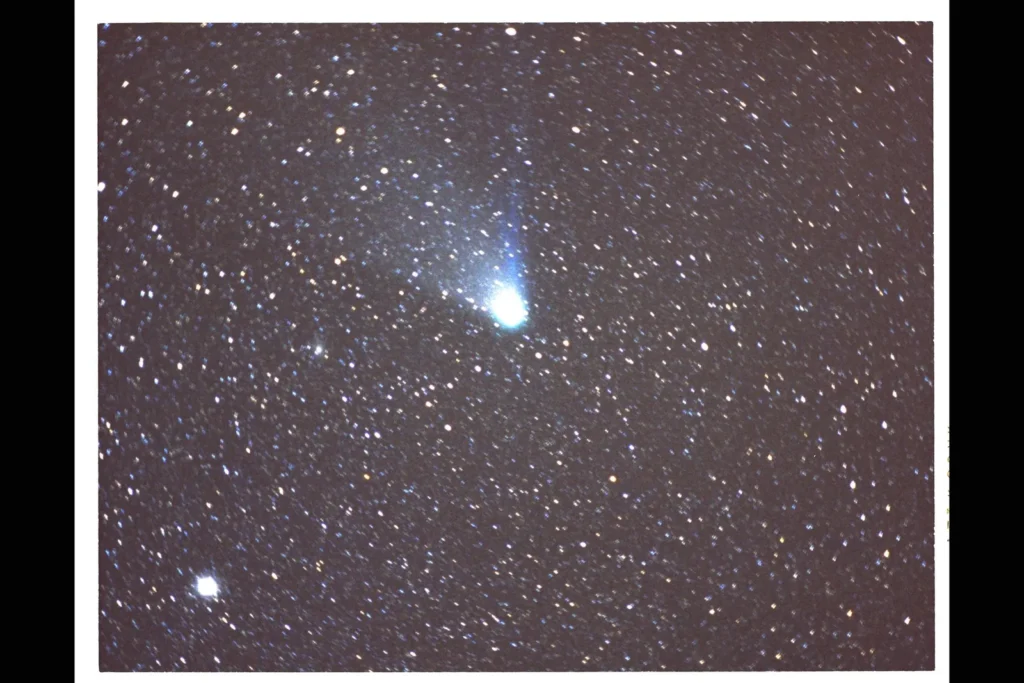
In early 1910, astronomers detected cyanogen, a poisonous gas, in the tail of Halley’s Comet, and Earth was due to pass through that tail in May. The French astronomer Camille Flammarion suggested the gas might affect the atmosphere, and newspapers ran alarming headlines. Some people sealed their windows, and salesmen sold “comet pills” as protection. The tail was far too thin to cause any harm, and Earth passed through it without anyone noticing.
6. 1914 and the end of the world order
Charles Taze Russell’s Bible Student movement, the forerunner of Jehovah’s Witnesses, taught that 1914 would mark the end of the present world order. The First World War began that year, which some saw as partial confirmation, but the world did not end, and later teachings reinterpreted the date.
7. Heaven’s Gate (1997)
Members of the Heaven’s Gate group in California believed a spacecraft was travelling behind the Hale-Bopp comet and would take them to a higher level of existence. In March 1997, 39 members died by suicide. It is a sobering reminder that end-times beliefs are not always harmless, especially when combined with an isolated group and a charismatic leader.
8. Y2K (2000)

The fear was technical, not religious. Many older computer systems stored years as two digits, so “00” might be read as 1900 instead of 2000, potentially causing failures in banks, power grids and airlines. Governments and companies spent hundreds of billions of dollars checking and fixing code. The new year passed with only minor problems. Some people concluded the danger had been exaggerated, but many engineers argue it was a success story: a real risk that was identified early and largely fixed.
9. Nibiru, the planet that does not exist (2003, 2012, 2017)
The claim that a hidden planet called Nibiru, or “Planet X”, is on a collision course with Earth first spread in the 1990s and was attached to several dates, including 2003, 2012 and 23 September 2017. Astronomers have repeatedly pointed out that a planet that close would be one of the brightest objects in the sky and impossible to hide. It does not exist.
10. Harold Camping and the Rapture (2011)
The American radio broadcaster Harold Camping predicted the Rapture on 21 May 2011, backed by a nationwide advertising campaign on billboards and buses. Some followers quit their jobs or spent their savings. When nothing happened, he moved the date to 21 October 2011. He had already made a failed prediction for 1994. In 2012 he acknowledged he had been wrong and said that trying to predict the date was a mistake.
11. The Maya calendar (2012)
21 December 2012 marked the end of a long cycle, called a b’ak’tun, in the Maya Long Count calendar. Online it became an end-of-the-world date, linked to rogue planets, pole shifts and solar storms. Maya scholars pointed out that the calendar simply rolled into a new cycle, much like a car’s odometer, and that the ancient Maya never predicted the end of the world on that date. NASA even released an explainer video in advance, titled “Why the World Didn’t End Yesterday”.
12. Blood moons (2014–2015)
A series of four total lunar eclipses, known as a tetrad, was linked by some preachers and a best-selling book to biblical prophecy and the end times. Lunar eclipses happen regularly and can be predicted centuries in advance. The four eclipses came and went.
Why do people keep predicting the end of the world?
A specific date feels certain
A date turns a vague fear into something concrete. It also makes a claim feel scientific, even when it comes from astrology or a reading of scripture.
Hard times make it feel plausible
Predictions often spread during wars, plagues, economic crises or rapid change, when the world already feels as if it is falling apart. That is one reason end-times talk is so common in 2026, a year we look at in Is the end of time starting?
Not every doomsday date comes from religion or astrology. A 1960 paper in the journal Science calculated that population growth would reach infinity on Friday 13 November 2026. We explain why it failed in Will the world end on 13 November 2026?
When prophecy fails, belief can grow stronger
In 1956, psychologist Leon Festinger and colleagues published When Prophecy Fails, a study of a small group in the US whose leader predicted a great flood in December 1954. When the flood did not come, the most committed members did not give up. Many became more convinced, explaining that their faith had saved the world. Festinger called the discomfort of holding beliefs that clash with reality “cognitive dissonance”. It helps explain why failed predictions so often lead to new dates.
What these predictions have in common
- A specific date, which makes the claim feel certain.
- A leader, text or calculation that seems authoritative.
- A sense that current events are uniquely bad.
- After failure, a new date or a new interpretation rather than a rethink.
Even Isaac Newton noticed this pattern. When he wrote down the year 2060, he said he did it to stop “fancifull men” from making rash predictions. Read the full story in our article on Newton and 2060.
How to judge the next end-of-the-world claim
- Ask where the date comes from. A calculation from scripture, numerology or astrology is not evidence about the physical world.
- Check what experts in the field say. Astronomers, for example, can tell you within minutes whether a planet or asteroid is real.
- Look for probabilities, not dates. Serious scientific warnings, such as the Doomsday Clock or estimates of AI risk, talk about likelihoods and what can be done, not a day when everything ends.
- Notice who benefits. Book sales, donations and clicks have driven many predictions.
Religious traditions themselves often warn against date-setting. Both the Gospel of Matthew and the Qur’an say the timing of the end is known only to God, as we explain in Signs of the end across religions and science.
Frequently asked questions
How many times has the world been predicted to end?
Hundreds of times at least. Historians have catalogued well over 100 specific dates since ancient times, and new ones appear every year online.
What was the most famous failed prediction?
The Great Disappointment of 1844 and the 2012 Maya calendar are among the best known. Y2K is the most famous technological scare.
Why didn’t the world end in 2012?
Because the Maya calendar never predicted it. 21 December 2012 was the end of one cycle in the Long Count calendar and the start of the next, and no astronomical threat existed.
What is the next predicted end of the world date?
New dates appear regularly online, and none has any scientific basis. One of the most often quoted is Isaac Newton’s 2060, which Newton himself did not mean as the destruction of the planet.
Has any end-of-the-world prediction come true?
No. The world has survived every predicted date so far. The risks humanity faces now are probabilities that can be reduced, and none of them comes with a date.
Sources and further reading
- Science History Institute: The comet panic of 1910 revisited
- Smithsonian: NASA assures us the world won’t end on Friday (2012)
- Encyclopaedia Britannica: William Miller and the history of Adventism
- Encyclopaedia Britannica: The beliefs of Heaven’s Gate
Related articles
Or start from the beginning: all predictions about the end of the world.
We explain what experts and sources have said in our own words and link to the originals so you can check them. If something here is wrong or out of date, let us know.