
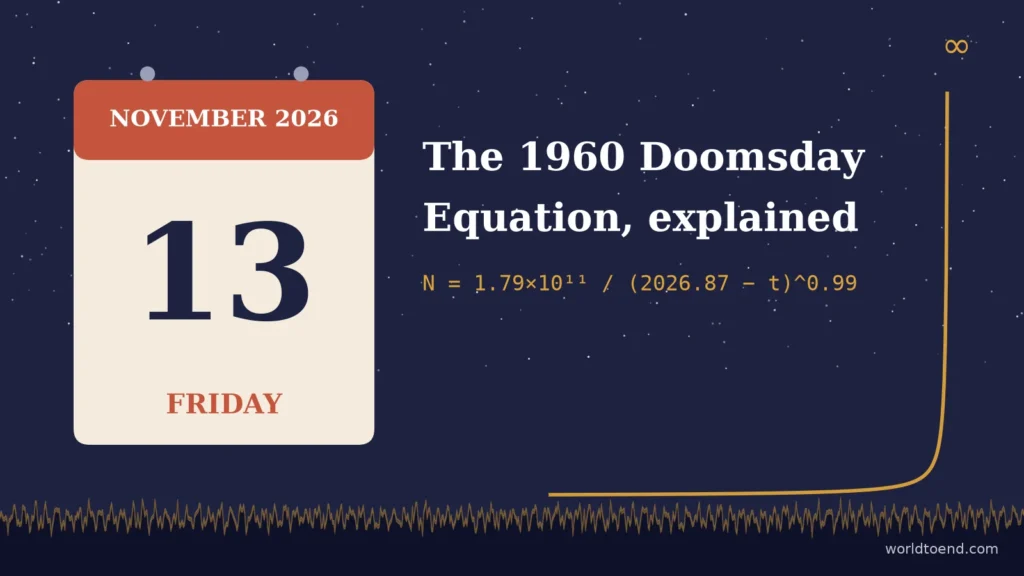
No. The world will not end on Friday 13 November 2026. The date comes from a 1960 paper in the journal Science, in which physicist Heinz von Foerster and two students calculated that, if human population kept growing the way it had for 2,000 years, it would reach infinity in late 2026. It was a warning about runaway population growth, not a prophecy, and it stopped matching reality in the 1990s. Today the world has about 8.2 billion people, not the 96 billion his formula predicted for 2025.
The date has gone viral again because it is now only weeks away, and headlines such as “Scientists predicted the end of the world for next month” travel fast. The real story is stranger and more interesting than the headlines: a brilliant scientist, a deliberately provocative title, a date that happened to be his own birthday, and an equation that worked almost perfectly for decades before it broke.
Key takeaways
- The prediction comes from “Doomsday: Friday, 13 November, A.D. 2026”, published in Science on 4 November 1960 by Heinz von Foerster, Patricia Mora and Lawrence Amiot.
- Their formula said world population would become infinite in 2026.87, give or take about five and a half years.
- The authors meant it as a warning that growth could not continue, and argued for cutting the global birth rate by half.
- The equation tracked real population closely until about 1990, then broke down as birth rates fell.
- The viral claim that “Harvard scientists” made the prediction is false. The authors worked at the University of Illinois.
What is the 13 November 2026 doomsday prediction?
On 4 November 1960, the prestigious journal Science published a four-page article with an intentionally dramatic title: “Doomsday: Friday, 13 November, A.D. 2026”. Its authors were Heinz von Foerster, a prominent Austrian-American physicist and cyberneticist, and two of his students at the University of Illinois: Patricia M. Mora and Lawrence W. Amiot.
The paper did not predict an asteroid strike, a nuclear apocalypse, a supervolcano, or a divine judgment. It made a mathematical point about human population.
Von Foerster and his team collected historical estimates of world population covering roughly two thousand years, from the time of Christ to the late 1950s. When they plotted the numbers, they discovered something that surprised them: the human population was not growing exponentially, as most biologists and demographers assumed. It was growing faster than exponentially.
In pure exponential growth, the percentage growth rate stays constant while the absolute numbers accelerate. But in human history up to 1960, the percentage growth rate itself was also rising. In 1 AD it took roughly a thousand years for the population to double; by 1960 it was doubling in less than 40 years.
When you fit a curve to that kind of super-exponential growth, the line does not just climb steeply; it becomes a vertical asymptote. At a specific moment in mathematical time, the value goes to infinity. When von Foerster ran the numbers, the asymptote landed on:
t0 = 2026.87 ± 5.5 years
Translated into a calendar date, 2026.87 is Friday 13 November 2026.
Who was Heinz von Foerster?
Heinz von Foerster was neither a crank nor a doomsday preacher. He was one of the most respected interdisciplinary thinkers of the twentieth century.
Born in Vienna in 1911, he studied physics at the Technical University of Vienna and the University of Breslau. In Vienna his circle included philosophers of the Vienna Circle, and he was a nephew of the philosopher Ludwig Wittgenstein. After the Second World War he moved to the United States, joined the University of Illinois at Urbana-Champaign, and in 1958 founded the Biological Computer Laboratory (BCL), a legendary research centre that pioneered cybernetics, neural networks, and systems theory.
Why did he choose Friday 13 November? The mathematics gave him 2026.87, which falls in mid-November. The thirteenth happened to be a Friday in 2026, which made for a delightfully macabre headline. But there was also a private joke: 13 November was von Foerster’s own birthday. On 13 November 2026, had he lived, he would have celebrated his 115th birthday. (He passed away in 2002, aged 90.)
The Doomsday Equation, explained in plain English
The equation published in Science looks intimidating at first glance, but the logic behind it is straightforward:
N(t) = 1.79 × 10¹¹ / (2026.87 − t)0.99
Here, N(t) is the world population in year t. Notice the term in the denominator: (2026.87 − t). As the current year t gets closer and closer to 2026.87, that number shrinks toward zero. Because you cannot divide by zero, dividing by a number approaching zero produces a result that shoots toward infinity.
The crucial detail is the exponent, 0.99. In standard exponential growth (the kind bacteria show in a petri dish with unlimited food), the formula would have a different structure and would never hit infinity at any finite date. The 0.99 exponent reflects positive feedback: in human history, more people meant more brains, more communication, more tools, better agriculture, and better medicine. Unlike fruit flies, humans actively altered their environment to support still more humans. Technology was feeding growth, which produced more technology, which fed more growth.
“They will be squeezed to death”: what the authors really meant
The most famous, and most quoted, sentence in the 1960 paper is this one:
“Our great-great-grandchildren will not starve to death. They will be squeezed to death.”
Heinz von Foerster, Patricia Mora, Lawrence Amiot (Science, 1960)

Because that sentence appears in a peer-reviewed scientific paper, readers today sometimes interpret it literally: that on 13 November 2026 human beings would be standing shoulder to shoulder across every square inch of the planet, crushing one another under physical pressure.
That was not von Foerster’s point. He was engaging in a classic philosophical technique: reductio ad absurdum. He was arguing:
- If you assume historical trends will simply continue without change, you get an impossible result: infinite population in 2026.
- Because an infinite population is physically impossible, the premise must be wrong: the historical trend cannot continue.
- Therefore, something fundamental must change between 1960 and 2026 to slow the growth rate down.
- The authors urged society to choose that change intentionally (through birth control and population policy) rather than wait for nature or war to impose it brutally.
How the world reacted in 1960
When the paper appeared in November 1960, it caused an immediate stir in the scientific community and the international press. Time magazine covered it. Demographers wrote furious letters to Science, pointing out that extrapolating an empirical curve into a singularity violated basic biological constraints.
Von Foerster was delighted. He responded politely to every critique, essentially saying: Of course it is impossible. That is the entire point. You are arguing with my equation when you should be arguing with the assumption that growth can continue indefinitely.
Was the Doomsday Equation accurate?
The shocking thing about von Foerster’s equation is not that it eventually broke. The shocking thing is how well it worked for thirty years after it was published.
Here is how the formula’s predictions compare with the real world population documented by the United Nations:
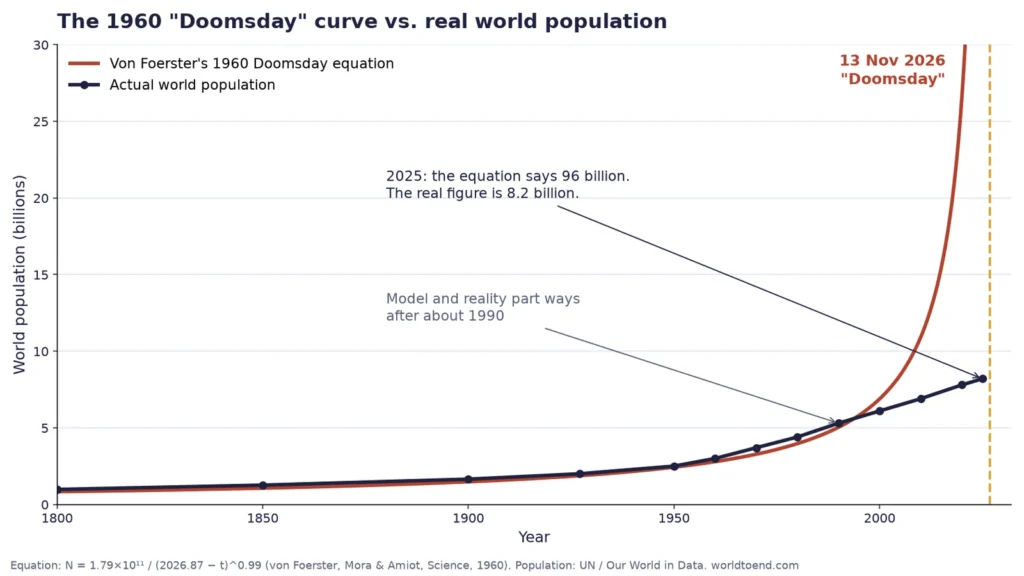
| Year | Von Foerster formula prediction | Actual world population (UN) | Difference |
|---|---|---|---|
| 1960 | 3.0 billion | 3.03 billion | −1% (spot on) |
| 1970 | 3.6 billion | 3.68 billion | −2% |
| 1980 | 4.4 billion | 4.46 billion | −1% |
| 1990 | 5.7 billion | 5.33 billion | +7% (formula pulls ahead) |
| 2000 | 8.0 billion | 6.14 billion | +30% (formula breaks away) |
| 2010 | 14.0 billion | 6.96 billion | +101% (formula doubles reality) |
| 2020 | 39.5 billion | 7.84 billion | Formula in runaway territory |
| 2025 | 96.0 billion | ~8.2 billion | Total divergence |
| Nov 2026 | Infinity | ~8.25 billion | Asymptote reached; reality stable |
Between 1960 and roughly 1985, von Foerster’s equation matched real human headcount with uncanny precision, tracking within a few percentage points of census reality. But by the 1990s, the curve began to tear away into science fiction.
Why the doomsday never came
The Doomsday Equation failed because human beings are not mathematical constants. The very thing von Foerster hoped would happen, happened: the growth rate changed.
- The global fertility transition: In the 1960s, the average woman globally had roughly 5 children. Today the global total fertility rate is roughly 2.25 children per woman, and in more than half of all countries it has fallen below the replacement level of 2.1.
- Education and empowerment of women: As girls gained access to secondary education and career opportunities, marriage ages rose and family sizes fell across every continent.
- Contraception and healthcare: Modern family planning became widely available worldwide from the late 1960s onward.
- Urbanisation: In rural farming economies, children are economic contributors. In urban apartments, children are major financial expenses. As humanity moved into cities, families naturally shrank.
According to the latest United Nations World Population Prospects report, world population is expected to peak in the mid-2080s at roughly 10.3 billion people, before slowly declining. Far from shooting to infinity, human numbers are approaching a stable plateau.
Did Harvard scientists predict the end of the world in 2026?
In recent years, viral videos on TikTok, YouTube Shorts, and Instagram Reels have claimed: “Harvard scientists calculated that the world will end on November 13, 2026!”
This is a classic game of digital Chinese whispers:
- The authors were not at Harvard: They were at the University of Illinois at Urbana-Champaign. Neither von Foerster, Mora, nor Amiot was affiliated with Harvard.
- It was not a prophesied apocalypse: It was a mathematical critique of super-exponential growth published 66 years ago.
- The paper was about population, not destruction: No asteroid, no virus, no sun explosion, and no supernatural event was involved.
Other “world ends in 2026” claims
Because the year 2026 has been in the public eye, several other fringe predictions have attached themselves to the same calendar year:
- Asteroid 2024 YR4: In late 2024, astronomers detected a near-Earth asteroid that briefly had an elevated impact probability for 2032 (not 2026). Subsequent observations ruled out any threat. NASA and ESA track all known near-Earth objects; none poses a catastrophic collision risk in 2026.
- Biblical and numerological claims: Various self-styled online prophets claim 2026 marks the end of a biblical “generation” since 1948 or 1967. Every single calendar year in the modern era has had similar claims attached to it, and none has ever come true.
- AI superintelligence timelines: Some AI researchers (such as Leopold Aschenbrenner and Dario Amodei) have written that Artificial General Intelligence (AGI) could arrive as early as 2026 or 2027. While this represents a genuine technological transformation, it is not an end-of-the-world event in November 2026.
What will actually happen on Friday 13 November 2026?
On Friday 13 November 2026, the Sun will rise over the Pacific, roughly 8.25 billion human beings will wake up, make coffee, go to work, attend school, and argue on the internet. In the Islamic lunar calendar, the date will correspond approximately to 3 Jumada al-Thani 1448 AH.
At the University of Illinois, someone in the physics department will probably raise a glass to Heinz von Foerster on what would have been his 115th birthday, remembering a brilliant mind who used a shock-value headline to force humanity to think about its limits.
So what should we actually worry about?
While von Foerster’s November 2026 doomsday date is harmless mathematical theatre, the broader question of human survival is not. Serious researchers at Oxford, Cambridge, and Berkeley calculate that humanity faces non-negligible existential risks this century, primarily from:
- Engineered pandemics: synthetic pathogens created using advanced biotechnology.
- Nuclear conflict: accidental escalation between major powers.
- Uncontrolled frontier AI: systems beyond human oversight and alignment.
- Extreme climate tipping points: irreversible changes to ecological systems.
These are real, ongoing challenges that require policy, diplomacy, and engineering. A sixty-year-old population formula that passed its expiration date thirty years ago is not one of them.
Frequently asked questions
Will the world end on 13 November 2026?
No. There is zero scientific, astronomical, geological, or epidemiological evidence that the world will end on 13 November 2026. The date originates from a 1960 mathematical model about population growth that stopped fitting real data in the 1990s.
What is the Doomsday Equation?
The Doomsday Equation is a mathematical formula published by Heinz von Foerster, Patricia Mora, and Lawrence Amiot in the journal Science in November 1960. It demonstrated that historical human population growth was super-exponential and would mathematically reach infinity on 13 November 2026 if the growth rate never slowed.
Who predicted the end of the world in 2026?
Austrian-American physicist Heinz von Foerster and his research students at the University of Illinois at Urbana-Champaign. They did not predict an actual physical destruction of the Earth, but used the provocative title to warn against unchecked population growth.
Why did they choose Friday 13 November?
The equation gave the mathematical date 2026.87, which falls in mid-November 2026. November 13 was a Friday, and it was also Heinz von Foerster’s own birthday. He would have turned 115 on that day.
What is the Islamic date of Friday 13 November 2026?
Friday 13 November 2026 corresponds approximately to 3 Jumada al-Thani 1448 AH in the Hijri calendar (exact date subject to local moon sighting).
What is the world population now?
As of late 2026, the world population is approximately 8.2 billion people, according to the United Nations Population Division. Von Foerster’s formula projected 96 billion by 2025, demonstrating how completely the runaway growth trend was averted by falling fertility rates.
Sources and further reading
- Von Foerster, Mora and Amiot (1960), Doomsday: Friday, 13 November, A.D. 2026, Science 132: 1291–1295
- ScienceDaily / The Conversation: Scientists predicted doomsday for November 13, 2026 (Alan MacEachern, 2026)
- Our World in Data: Population growth
- United Nations: World Population Prospects 2024
- Chequeado: fact-check of the “Harvard 2026” claim
- Gizmodo: Scientists once calculated the date of doomsday, and it’s next month
Related articles
Or start from the beginning: all predictions about the end of the world.
Written by Marcus Vance, founder and administrator of WorldToEnd. He has been analyzing global existential risks, catastrophic forecasts, and cosmic timelines for years, investigating the boundary between sensational media claims and empirical scientific reality. Spotted an error? Tell us and we will investigate.