
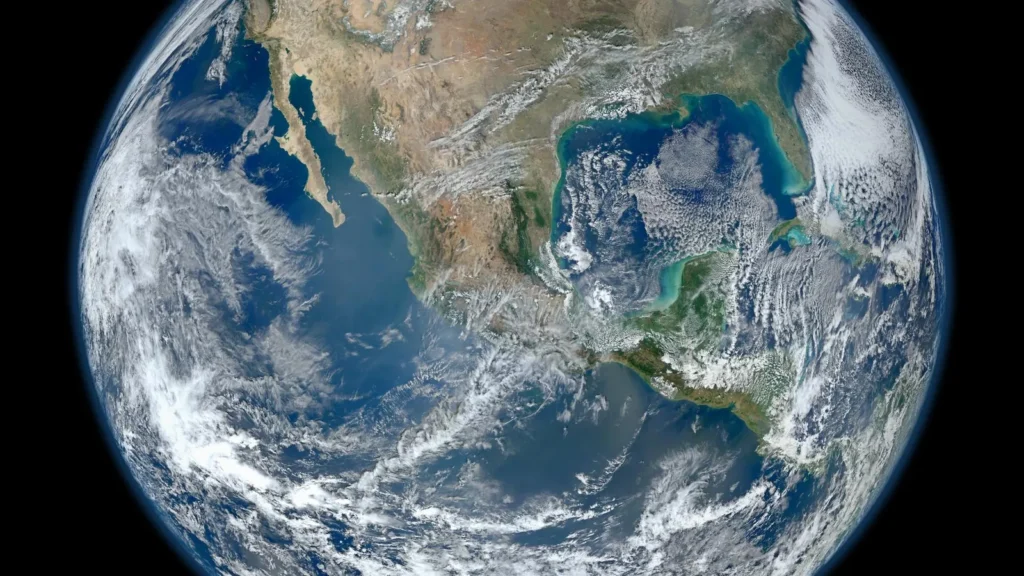
Science gives three answers rather than one date. Human civilisation could end this century, but only if we cause it ourselves. Complex life on Earth will become impossible in roughly 1 billion years as the Sun grows brighter. And the universe itself will run down over about 10100 years, ending in a cold, dark state called heat death.
That spread, from decades to a number with a hundred zeros, is why the question confuses so many people. Taking the stages in order, from nearest to furthest, makes it much easier to separate what is likely from what is only possible.
Will the world end in our lifetime?
Almost certainly not from natural causes. The odds of a planet-ending asteroid, supervolcano or stellar explosion in the next 100 years are tiny. Philosopher Toby Ord, who has studied these numbers more closely than most, puts all natural risks combined at about 1 in 10,000 per century.
The risks that worry scientists are the ones we create. In January 2026 the experts behind the Doomsday Clock set it to 85 seconds to midnight, the closest it has ever been, citing nuclear weapons, climate change, biological threats and artificial intelligence. Ord’s own estimate for an existential catastrophe this century is about 1 in 6, which we unpack in our guide to the odds of human extinction.
The important word is “could”. A human-made catastrophe is a risk, not a schedule, and risks can be reduced.
Stage 1: This century, the risks we create
For most of history, the biggest threats came from nature. Since the first atomic bomb test in 1945, humanity has had the power to damage itself on a global scale, and that power has kept growing.
Nuclear war
Around 12,000 nuclear warheads still exist. Beyond the direct destruction, studies of “nuclear winter” suggest that smoke from burning cities could block sunlight and cause global crop failures, so even a regional war could threaten food supplies far from the fighting.
Engineered pandemics
COVID-19 showed how quickly a new disease can spread through a connected world. Biologists worry most about pathogens that are deliberately made more dangerous, because biotechnology is getting cheaper and easier to use.
Climate change
Climate change is very unlikely to wipe out humanity on its own, but it adds pressure everywhere: heat, drought, migration and conflict. Scientists describe it as a “threat multiplier” that makes other risks worse.
Artificial intelligence
A growing number of AI researchers, including Nobel laureate Geoffrey Hinton, warn that systems smarter than us could become impossible to control. Others think the danger is overstated. Either way, AI is now one of the four threats the Doomsday Clock tracks.
Astrophysicist Neil deGrasse Tyson makes the same point in interviews: the Sun’s end is billions of years away, but the problems humans have created are much closer.
What about asteroids, supervolcanoes and other natural disasters?
Natural catastrophes have reshaped life on Earth before, and they will again. They are simply rare on human timescales.
- Asteroids: an asteroid about 10 km wide helped end the age of the dinosaurs 66 million years ago. Impacts that large happen roughly once every 100 million years. NASA’s planetary defence programme has found the vast majority of near-Earth asteroids larger than 1 km, and none is on course to hit us in the next century. In 2022 its DART mission showed that a spacecraft can nudge an asteroid off course.
- Supervolcanoes: an eruption like Yellowstone’s last major one, about 631,000 years ago, would be a global disaster, causing years of cooling and crop failures. It would not end the world, and the US Geological Survey sees no sign of one coming soon.
- Gamma-ray bursts and nearby supernovas: these could strip away the ozone layer, but no star close enough to do serious damage is expected to explode for millions of years.
- Apophis: the asteroid that will pass unusually close to Earth on 13 April 2029 will miss us. NASA has ruled out an impact for at least the next 100 years.
Stage 2: About 1 billion years, the Sun gets too bright
This is the first ending that is not a matter of chance. The Sun is a middle-aged star, about 4.6 billion years old, and it is slowly getting brighter, by roughly 10% every billion years. When Earth formed, the young Sun shone about 30% less brightly than it does today.
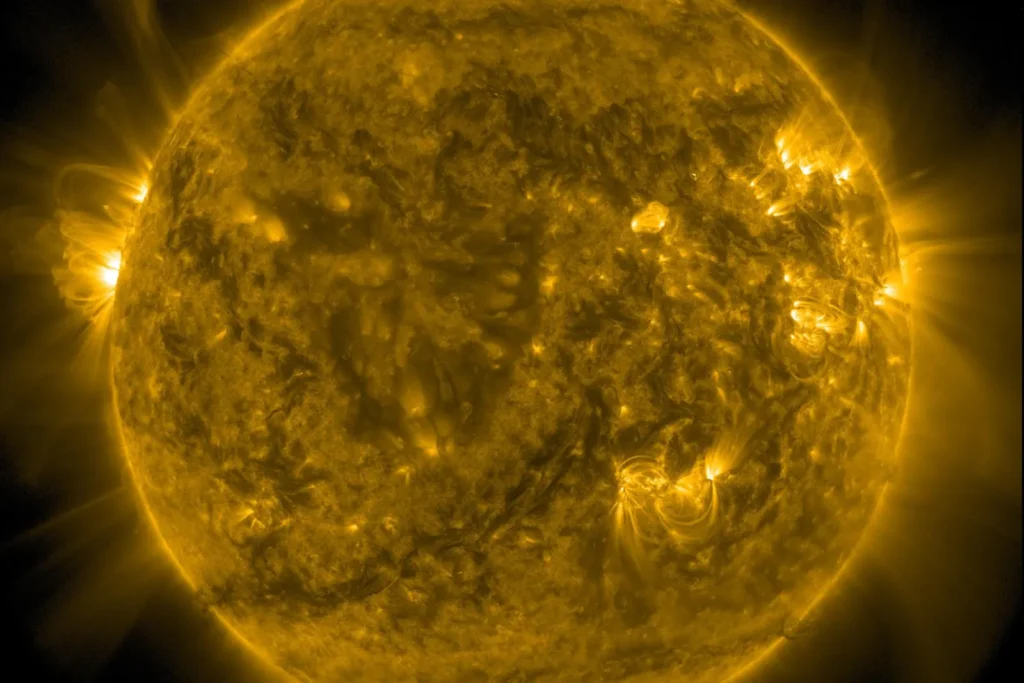
That extra energy changes Earth in stages. Warmer temperatures speed up the weathering of rocks, which pulls carbon dioxide out of the air. Over hundreds of millions of years there will be too little CO2 left for most plants to photosynthesise, and food chains will collapse from the bottom up. Later, more water vapour in the atmosphere traps more heat, sunlight splits water molecules high in the air, and the hydrogen escapes to space. Climate scientists call this a “moist greenhouse”. Most models put the end of complex life at around 1 billion years from now, with microbes surviving longer underground.
We explain each step in Earth’s expiration date.
Stage 3: About 5 billion years, the Sun becomes a red giant
In about 5 billion years the Sun will run out of hydrogen in its core. The core will contract and heat up, and the outer layers will swell into a red giant more than 100 times the Sun’s current width. Mercury and Venus will be swallowed.
Will the Sun swallow the Earth?
Possibly. As the Sun swells it will also lose a large part of its mass, which weakens its gravity and lets Earth’s orbit drift outward. Some models say Earth just escapes. A widely cited 2008 study by Klaus-Peter Schröder and Robert Connon Smith found that tidal drag would probably pull Earth in anyway. Either way, Earth will have been a dead, scorched rock for billions of years by then.
After the red giant phase, the Sun will shed its outer layers into a glowing planetary nebula and shrink into a white dwarf, a cooling ember about the size of Earth.
What about the collision with Andromeda?
For years, astronomers said our Milky Way would collide with the Andromeda galaxy in about 4.5 billion years. A 2025 study using newer data from the Hubble and Gaia space telescopes found the odds of a collision in the next 10 billion years are closer to 50-50. Even if it happens, stars are so far apart that they almost never hit each other. The night sky would change, but the Solar System would most likely survive.
Stage 4: Trillions of years and beyond, the universe runs down
Even the universe has an end state. The second law of thermodynamics says energy spreads out over time. Stars, planets and life all depend on energy being unevenly spread, so once it is evenly spread, nothing more can happen.
In practice, the gas needed for new stars will run out. The smallest red dwarf stars, which burn very slowly, will be the last to fade after roughly 100 trillion years. After that come dead stars and black holes, and over about 10100 years the black holes slowly evaporate through Hawking radiation. The likely final state is heat death: a cold, dark universe where almost nothing happens. See our heat death timeline for the full sequence.
Could the universe end differently?
Heat death is the leading prediction, not a certainty. If dark energy grows stronger over time, expansion could tear everything apart in a “Big Rip”. If it weakens, as some 2025 measurements from the DESI survey hinted, expansion might one day slow or even reverse into a “Big Crunch”. These are open questions in cosmology, and none of them would happen for many billions of years.
The full timeline at a glance
| When | What ends | Main cause |
|---|---|---|
| This century (possible, not certain) | Human civilisation | Nuclear war, pandemics, AI, climate |
| Any time (very unlikely per century) | Much of life on Earth | Large asteroid or supervolcano |
| ~1 billion years | Complex life on Earth | The Sun getting brighter |
| ~5 billion years | Earth as we know it | The Sun becoming a red giant |
| ~1014 years | The age of stars | Gas for new stars runs out |
| ~10100 years | Black holes and almost all activity | Heat death |
What this means for you
The scientific answer is both reassuring and demanding. Reassuring, because the natural endings are so far away that they have no bearing on our lives. Demanding, because the risks that matter this century are the ones we create, which means people, governments and scientists can reduce them.
Philosophers like Toby Ord argue that this makes our era unusually important: if humanity gets through the next century or two safely, it could have billions of years ahead of it. Religions frame the end very differently, with signs and moral meaning instead of probabilities. We compare the two in Signs of the end across religions and science.
Frequently asked questions
When will the world end according to science?
There is no single date. Civilisation could end this century only through human-made catastrophe, complex life on Earth has about 1 billion years left, the Sun becomes a red giant in about 5 billion years, and the universe fades out over about 10100 years.
Will the world end in 2026?
No. There is no scientific evidence for an end of the world in 2026 or any other specific year. The concerns behind the 2026 Doomsday Clock setting are risks to be reduced, not predictions. We look at the year’s events in Is the end of time starting?
How long until Earth is uninhabitable?
For complex life, roughly 1 billion years, give or take a few hundred million. Microbes living deep underground could survive somewhat longer.
Will the Sun swallow the Earth?
It will swallow Mercury and Venus. Whether it also swallows Earth is still debated, but Earth will be uninhabitable long before then either way.
Could an asteroid end the world?
A very large impact could, but none is known to be on a collision course. NASA tracks near-Earth objects and has tested a way to deflect them.
Sources and further reading
- NASA: Sun facts
- NASA: Planetary defence
- Bulletin of the Atomic Scientists: Doomsday Clock
- Schröder and Smith (2008), Distant future of the Sun and Earth revisited
- Adams and Laughlin (1997), A dying universe
- US Geological Survey: Yellowstone Volcano Observatory
Related articles
Or start from the beginning: all predictions about the end of the world.
Every claim above links to its original source so you can read it for yourself. Spotted a mistake or something out of date? Tell us and we will fix it.