
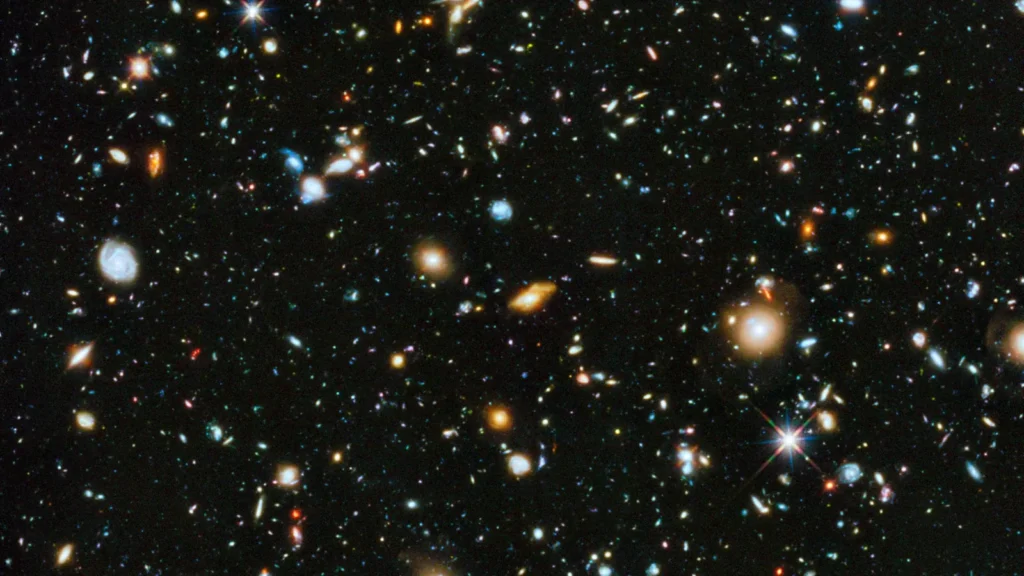
Heat death is the most widely accepted prediction for how the universe ends. Because the universe keeps expanding and energy keeps spreading out, new stars will stop forming, the last stars will fade after about 100 trillion years, black holes will evaporate over about 10100 years, and the universe will settle into a cold, dark state where almost nothing can happen. It is sometimes called the “Big Freeze”.
It’s the most distant ending anyone has calculated, and the most final. Physicists aren’t certain of it either: a few rival endings are still possible, and they’re covered further down.
What is the heat death of the universe?
Heat death is a state of maximum entropy. In everyday terms, entropy measures how spread out energy is. A hot cup of coffee in a cold room has low entropy: the heat is concentrated in one place. Leave it for an hour and the heat spreads into the room until coffee and air are the same temperature. Nothing more happens, because there is no longer any difference in temperature to drive a change.
The universe is a much larger version of that cup of coffee. Stars are concentrated sources of energy shining into cold, empty space. Every process that matters, from weather on Earth to life itself, runs on that difference. Heat death is the point at which the difference is gone everywhere.
The idea is old. In the 1850s, physicists William Thomson (Lord Kelvin) and Rudolf Clausius realised that the laws of thermodynamics implied the universe was running down. Modern cosmology has added the timescales.
Why will the universe run down?
Two facts point towards heat death.
The first is the second law of thermodynamics, one of the best-tested laws in physics. In an isolated system, entropy never decreases on average. The universe, as far as we know, is the ultimate isolated system.
The second is the way the universe is expanding. In 1998, two teams studying distant exploding stars found that the expansion is accelerating, a discovery that won the 2011 Nobel Prize in Physics. The cause is called dark energy, and it makes up about 68% of the universe’s total energy content. If it stays constant, galaxies will drift ever further apart, matter will thin out, and the universe will keep cooling towards absolute zero.
The eras of the universe: a timeline to heat death
In 1997, astronomers Fred Adams and Greg Laughlin divided the future of the universe into eras. Each one lasts vastly longer than the one before.
| Era | Roughly when | What happens |
|---|---|---|
| Stelliferous era (now) | Up to ~1014 years | Stars form and shine. Gas for new stars slowly runs out. |
| Degenerate era | ~1014 to ~1040 years | Only stellar remnants remain: white dwarfs, neutron stars and black holes. Protons may decay, if they decay at all. |
| Black hole era | ~1040 to ~10100 years | Black holes are the last large objects, slowly evaporating through Hawking radiation. |
| Dark era | After ~10100 years | A thin, cold sea of particles and very low-energy light. Almost nothing happens. |
The last stars
Our Sun will last about 10 billion years in total. Small red dwarf stars burn their fuel so slowly that they can shine for trillions of years. They will be the last stars in the universe, and when they go out, after roughly 100 trillion years, the lights go out with them. What remains are cooling white dwarfs that eventually become cold, dark “black dwarfs”.
Do protons decay?
Many theories in particle physics predict that protons, the building blocks of every atom, are not quite eternal. If they decay, all ordinary matter would eventually dissolve. Experiments such as Super-Kamiokande in Japan have watched huge tanks of water for decades without seeing a single proton decay, which shows their lifetime must be longer than about 1034 years. Whether they decay at all is still unknown.

How black holes evaporate
In 1974, Stephen Hawking showed that black holes are not completely black. Quantum effects near the edge of a black hole make it give off a faint glow, now called Hawking radiation, and slowly lose mass. For a black hole the mass of the Sun, this takes about 1067 years. The most massive black holes, billions of times heavier than the Sun, could last around 10100 years, a number known as a googol. When the last one evaporates, the universe enters the dark era.
Brian Cox on the death of the stars
In the BBC series Wonders of the Universe, physicist Brian Cox explains how the last stars will cool into black dwarfs, and uses a rusting shipwreck in the Namib Desert to show the slow, unstoppable rise of entropy.
Is heat death certain? Other ways the universe could end
Heat death is the leading prediction because it fits current data best, but it depends on how dark energy behaves, and nobody yet knows what dark energy is.
- Big Rip: if dark energy grows stronger over time, expansion could eventually overcome every force holding matter together, tearing apart galaxies, then stars, then atoms.
- Big Crunch: if dark energy weakens or reverses, gravity could win, and the universe could slow down, stop and collapse back on itself. Some physicists add a “Big Bounce”, in which a collapse leads to a new expansion.
- Vacuum decay: measurements of the Higgs boson suggest our universe may sit in a state that is stable for now but not permanently. If a lower-energy state formed somewhere, a bubble of it could expand at nearly the speed of light, rewriting the laws of physics inside it. This is speculative, and if it happens at all, it is expected to be extraordinarily unlikely on any timescale that matters to us.
In 2024 and 2025, the Dark Energy Spectroscopic Instrument (DESI), which has mapped millions of galaxies, reported hints that dark energy may be weakening over time. The results are not yet conclusive, but if they hold up, they would make a constant, eternal expansion less certain and could shift the odds away from a pure heat death.
Could anything survive heat death?
Physicists have asked this seriously. In 1979, Freeman Dyson argued that intelligent life could, in principle, survive forever in an expanding universe by thinking more and more slowly and hibernating for long periods to save energy. Later work, including a 1999 paper by Lawrence Krauss and Glenn Starkman, found that accelerating expansion makes this much harder, because a civilisation would be cut off from most of the universe’s resources.
No known form of life could survive a true heat death. Whether that is the actual future depends on physics we do not yet understand.
Should we worry about heat death?
Not personally. Long before any of this, the Sun will swell into a red giant, and Earth will be uninhabitable within about a billion years. The time scales of heat death are so long that even writing them down is difficult: 10100 is a 1 followed by a hundred zeros, far more years than there are atoms in the observable universe.
For many people, though, heat death is not a cause for worry but for perspective. The universe is about 13.8 billion years old, which means we live very early in its history, during the brief era when stars shine and complex chemistry is possible. Humanity’s real challenges are much closer, as our full timeline of the end shows.
Frequently asked questions
When will the heat death of the universe happen?
There is no exact date, because heat death is a gradual process. Star formation ends after about 1014 years, and the last black holes evaporate after about 10100 years, after which the universe is effectively in heat death.
Is heat death the same as the Big Freeze?
Yes. “Big Freeze” describes the same outcome: an ever-expanding universe that cools towards absolute zero.
Can heat death be reversed?
Not according to known physics. The second law of thermodynamics means total entropy does not decrease. Some speculative ideas involve random fluctuations over unimaginably long times, but there is no evidence for them.
Will the universe end in a Big Crunch instead?
Current evidence favours continued expansion, but recent DESI results suggest dark energy may be changing over time. If it weakens enough, a Big Crunch becomes possible again. Cosmologists expect better data within the next decade.
What will the universe look like in a trillion years?
Darker and emptier. Galaxies outside our own local group will have moved beyond view, so future astronomers, if any exist, would see only one merged galaxy in an otherwise black sky.
Sources and further reading
- Adams and Laughlin (1997), A dying universe: the long-term fate and evolution of astrophysical objects
- Nobel Prize in Physics 2011: the accelerating expansion of the universe
- NASA: Dark energy
- Hawking (1974), Black hole explosions?
- Berkeley Lab: New DESI results strengthen hints that dark energy may evolve
- Krauss and Starkman (1999), Life, the universe, and nothing
Related articles
Or start from the beginning: all predictions about the end of the world.
Every claim above links to its original source so you can read it for yourself. Spotted a mistake or something out of date? Tell us and we will fix it.